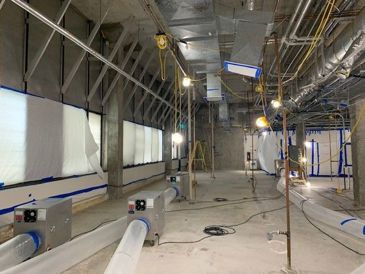
IR/Cath and Sim Labs

What are these spaces used for?

IR (interventional radiology) lab

A space where doctors use medical imaging techniques to diagnose and treat a variety of conditions. Doctors use real-time images to help guide them so their patients don’t have to have invasive surgeries.

Cath (cardiac catheterization) lab

A place where doctors use small flexible tubes called catheters to reach the heart. They use this minimally invasive technique instead of surgery to perform tests and other cardiac procedures.

Sim (simulation) lab

A space where health care providers and caregivers can learn in a virtual, risk-free environment. Learn more about CHEO’s SIM program.

A BIG impact for our children, youth and families

CHEO's new state-of-the-art IR/Cath lab will support some of CHEO's sickest children and youth, without the need to travel offsite. Our new SIM lab will  help health care providers and caregivers  learn in a safe, risk-free environment. 

Improvements made
  • The new IR/Cath lab will be home to the most state-of-the-art equipment so CHEO can support more children and youth by offering a broader range of services.
  •  Improved technology means CHEO can take part in more studies to advance care for children and youth.
  • Children and youth will receive care from the different teams at CHEO without having to travel offsite, reducing stress for families and improving continuity of care.
  • The new SIM lab will allow all health-care providers at CHEO to train in a realistic, interactive environment to hone their skills and improve patient outcomes.
Faster Access

Children and youth will receive faster access to care since they won’t need to be transported offsite for various procedures — we can do them in our new state-of-the art space!

Safety First
  • Since children and youth will not have to go offsite, there will no more travel-related risks.

  • Learners will have a brand new, state-of-the-art space to learn in a risk-free SIM environment.

News Updates

CHEO, the pediatric health and research centre in Canada’s capital, is now home to world-class technology that will enhance safety and improve access to diagnostic procedures and treatment for young patients.

In January 2020 CHEO broke ground on a project to revamp our catheterization (cath) and interventional radiology (IR) labs and build a new state-of-the-art simulation (Sim) lab for medical learners – spaces that will support some of CHEO’s sickest children and youth and provide medical learners with a risk-free training environment.  

After months of demolition, we’re excited towelcome some of the new tech that will bring these labs to life! We want to give you a breakdown of some of the equipment we’re most excited about:  

The Siemens Artis Q Zen Biplane is a 3D imaging machine. It helps guide doctors diagnose and treat a variety of conditions.

These are high-tech “filing cabinets” that will help organize and manage the large inventory of items required by Cardiology Catheterization services and Interventional Radiology services at CHEO.

This machine is used to inject contrast into a patient's blood system so clinicians can get a better view of blood vessels.  

This piece of equipment is mounted to the ceiling and provides medical gas and other connections to the anesthesia gas machine, without the need to use long cable and hoses.

SMOTS is an audiovisual debriefing system that allows medical learners to live stream and record simulations as well as offer instant playback for video debriefing.

Thank you donors 

Funds for this project were made possible, in part, by a generous $2 million donation from CP and the 2017 CP Women’s Open through the CHEO Foundation.  

The CHEO Foundation raises funds to support the work of CHEO, the CHEO Research Institute and Roger Neilson House and helps children and youth to live their best lives. 
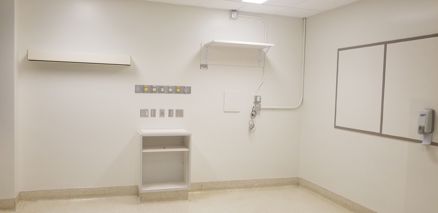
CHEO interventional radiology is constantly growing and expanding

Changes at CHEO to transform pediatric care in the region 

In anticipation of CHEO’s new IR Cath and Sim labs opening later this year, CHEO is thrilled to welcome Dr. Gali Shapira Zaltsberg to its interventional radiology program. Her clinical interest is in the area of vascular access and GJ tube insertion.  

“The main thing that drew me to CHEO is the people,” said Dr. Shapira Zaltsberg. “Having been here for my fellowship in pediatric radiology, I have gotten to know the great team that makes the diagnostic imaging  (DI) department and was more than happy to come back.” 

The newly renovated state-of-the-art lab space and 3D equipment will allows members of CHEO's DI team to perform new procedures onsite like gastrostomy-jejunostomy (GJ) tube insertions — permanent feeding tubes required by some of CHEO’s sickest children and youth and vascular access procedures like cuffed PICCs (peripherally inserted central catheter).  

Cuffed PICCs happening now  

Although the new lab space is still under construction, Dr. Shapira Zaltsberg is already putting her skills to use, performing procedures never before offered at CHEO and offering training to existing CHEO medical staff.  

One such procedure is installing cuffed PICCs. A PICC  is a thin, soft, long catheter (tube) that is inserted into a vein in a child's arm, leg or neck. The tip of the catheter is positioned in a large vein that carries blood into the heart. The PICC  is used for long-term intravenous (IV) antibiotics, nutrition or medications, and for blood draws 

A cuff on the catheter is then placed underneath the skin and, over time,  the body tissues will grow onto the cuff. Cuffs are unique to pediatric care because they help keep the catheter in place, eliminating the risk of a small child pulling it out. The cuff also keeps germs from getting into the blood stream around the catheter. 

Cuffed PICC’s are also meant to stay in much longer eliminating the need to have a standard PICC line replaced every 2-3 weeks. 

"CHEO interventional radiology is constantly growing and expanding, and I am delighted to be part of this challenging process,” said. Dr. Shapira Zaltsberg. “  As part of this process, I face many opportunities to step out of my comfort zone, helping me grow professionally and personally.”  

Thank you donors 

Funds for this project were made possible, in part, by a generous $2 million donation from CP and the 2017 CP Women’s Open through the CHEO Foundation.  

The CHEO Foundation raises funds to support the work of CHEO, the CHEO Research Institute and Roger Neilson House and helps children and youth to live their best lives. 
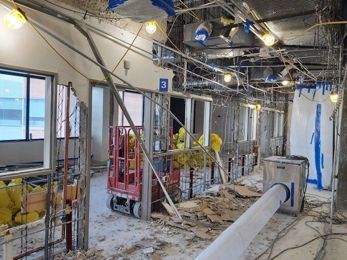
  • Demo is done! Thank you so much for the patience of families visiting the affected areas during the noisiest and most disruptive part of this project.  We went from this...
Before

To this...

During
To this! A blank canvas that will soon be home to our new IR Cath and Sim labs! 
Currently

Thank you!

Funds for this project were made possible, in part, by a generous $2 million donation from CP and the 2017 CP Women’s Open through the CHEO Foundation. 

The CHEO Foundation raises funds to support the work of CHEO, the CHEO Research Institute and Roger Neilson House by helping children and youth live their best lives. 

Learn more about Corporate Gifting.

Have you registered for MyChart?

MyChart is a free, secure, online patient portal that connects patients to parts of their CHEO electronic health record, anywhere, at any time.