
- Pain with movement or use of the injured arm
- Swelling around the wrist
- Often caused by a fall onto an outstretched arm
Distal Forearm Buckle Fractures
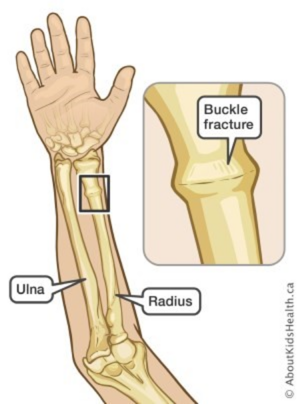
Distal forearm buckle fractures are a common type of broken bone in children and youth. The forearm is made up of two bones, the radius and the ulna. Because children often brace a fall with an outstretched arm, and their bones are softer and more flexible than adult bones, buckle fractures can occur near the wrist.
What you need to know
- Buckle (torus) fractures are the most common forearm fractures in children and youth.
- The bone is not fully broken but appears “buckled” on X-ray.
- These fractures heal very well and usually do not require a cast or follow-up appointment.
A buckle fracture is diagnosed with an X-ray of the wrist. The X-ray shows a compressed or buckled appearance along the outer edge of the radius, the ulna, or both bones.
If the X-ray shows a buckle fracture of the radius, ulna, or both, your provider will recommend a removable splint instead of a cast.
- Research at CHEO and other hospitals shows that splints are better than casts for buckle fractures.
- The splint may be made in the Emergency Department using fiberglass or plaster.
- Commercial splints can be purchased at the KidCare pharmacy on the second floor or at other pharmacies that sell home health-care products.
- Removable splints make dressing and bathing easier.
Your child or youth will be fitted with a removable splint or you may purchase one from a pharmacy.
Aftercare / What to do at home
- Pain or swelling is common during the first 24 to 48 hours after the injury.
- Pain can be treated with appropriate doses of Ibuprofen (Advil®, Motrin®) or Acetaminophen (Tylenol®, Tempra®) as needed.
- Swelling may be reduced by raising the injured arm above the level of the heart.
- The splint should be worn only for comfort.
- Your child or youth can wear the splint less as pain improves and stop using it at any time.
- We recommend that the splint be used for longer than three weeks. Most children stop using it sooner. These types of injuries often take 4 weeks to fully heal; it is important to not engage in activities that are at high risk of reinjury at that time.
Contact your health care provider if your child or youth:
- Has worsening pain or swelling that does not improve
- Is unable to use their wrist or hand after the expected healing period
Go to the Emergency Department if:
- Pain is severe and not controlled with medication
- There is new numbness, tingling, or colour change in the hand or fingers
Need Help Right Now?
Disclaimer
These resources are for educational purposes only. If you have questions, speak with your health care provider. Last updated: June 2026
Have you registered for MyChart?
MyChart is a free, secure, online patient portal that connects patients to parts of their CHEO electronic health record, anywhere, at any time.