
Hip Spica Casts
A hip spica cast is a special kind of cast used to keep hips and legs in the correct position after some hip or leg surgeries. Your child or youth might be in their hip spica cast anywhere from four weeks to three months.
Taking care of hip spica casts
In addition to following the instructions on CHEO’s separate cast care handout, hip spica casts require additional special care:
- It is important to try and keep the cast clean and dry from urine and stool. If the padding on the inside of the cast gets wet or dirty, it can cause skin breakdown (sores, ulcers or open cuts).
- Children who are in a hip spica should wear a bib when eating to prevent food from falling into the top of the cast. Taking care of your child or youth Hip spica casts will limit your child’s mobility significantly and as their parent or guardian you will play an important role in their care.
Preventing skin problems
Pressure on the skin from the hip spica cast can cause sores or skin ulcers. It’s important to check your child’s skin every day.
- Check the skin at the edges of the cast for redness or open cuts.
- Check for anything that could irritate the skin under the cast. Feel under the cast and try to remove food particles or anything else that may have gotten under the cast.
- Check for good blood circulation. Your child’s toes should be warm and pink and they should be able to easily wiggle them. There should be no numbness or tingling in the toes.
- Change your child’s position every three hours during the day and during the night. This will prevent pressure areas inside the cast. Keep their heels off their mattress by placing a pillow under the calves. If your child likes to sleep on their tummy, place a flat pillow under their chest.
Changing your child’s diaper
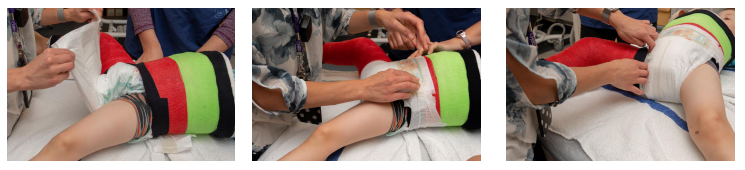
To keep the cast clean and free of urine or stool, the following diaper technique is recommended. When you are in hospital, your nurse or nurse practitioner can demonstrate this technique on your child so you are comfortable changing your child at home. Their diaper should be changed every 2-3 hours.
Watch the video
Supplies:
- two diapers: your child’s current size and one size larger
- two sanitary napkins
Step 1: Lay your child on a flat changing surface and get all the supplies you will need nearby.
Step 2: Unwrap the sanitary pad and place it directly over your child’s genital area. Tuck the top portion into the front of the cast.
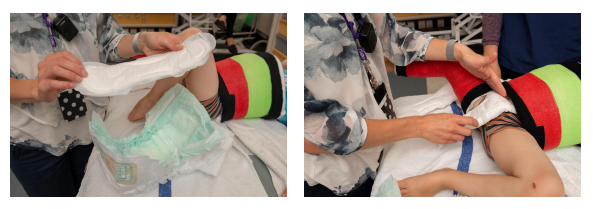
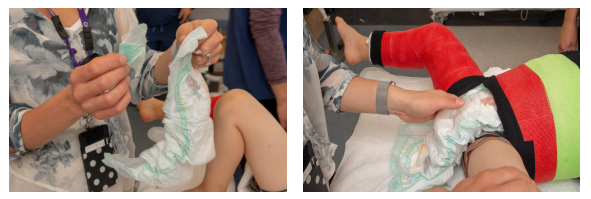
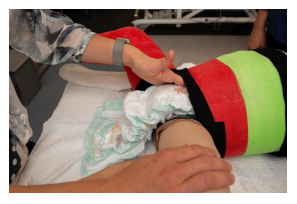
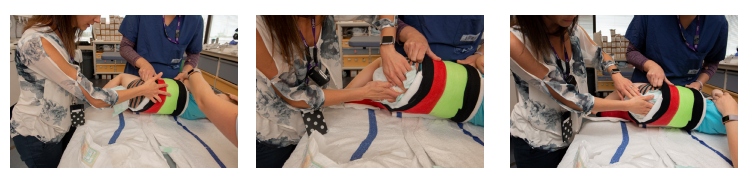
Step 6: Place the larger diaper underneath your child. If you would like to add extra protection, place a sanitary pad into the lower abdomen region. Folding may be required.
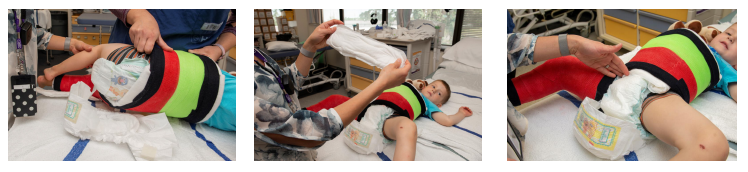
Step 7: Secure the larger diaper around your child’s waist. Tuck the diaper into the sides of the cast at the pelvis and all around the casted leg.
Using a bedpan
If your child no longer wears diapers, they can use a bedpan to void and for bowel movements. Older boy and girls can use a urinal tool to void. It may be easier to sit your child directly on the toilet.
If you choose to do this, you will need to support them by holding them in a sitting position.
Step 1: Tuck a towel under the back edge of the cast to keep the backside from getting soiled.
Step 2: Place 2-3 pillows behind your child’s head and back. This will make it easier to use the bedpan and help prevent the contents of the pan from leaking up the back of the cast.
Bathing and hair washing
Give your child a daily sponge bath to uncovered areas of the skin. Make sure that the cast stays dry. For hair washing, smaller children can lie on their backs on the kitchen counter with their head over the sink. Older children and youth can use a hair washing tray to wash their hair in bed (private insurance companies usually cover this). They can also lie across the bed with their head hanging over the side of a large bucket.
Tips:
- Some families choose to purchase dry shampoo or no-rinse hair caps to wash their child’s hair.
- A few drops of eucalyptus oil can be put directly onto the cast around the diaper area in the cast to combat odour. Do not place the oil directly onto your child’s skin or genitals.
Activity
Your child or youth won’t be able to be physically active in a hip spica cast, and might not be able to go to school. If they can’t go to school, you’ll need to arrange home tutoring. It will be important to keep your child engaged and entertained with quiet activities like:
- puzzles
- movies or video games
- books
- arts and crafts
- music
- table-top toys (LEGO®, action figures, dolls etc.)
A reclining chair or a lounge chair is best for seating older children. Younger children might enjoy sitting in a beanbag chair, or a modified seat. Spica tables or chairs can be purchased online or you can look up instructions on how to make them yourself.
Transportation
If your child is not able to sit properly in their usual car seat, you can rent a special hip spica car seat. Older children who are able to lie across the back seat of a vehicle can be transported with an E-Z-On vest. Medical supply vendors can rent these items to you. Parents will need to arrange for a private land ambulance to safely transport children who can’t use these.
Younger children with spica casts enjoy sitting in a wagon with a few pillows to prop them up in a modified sitting position. This can be very useful in warmer weather to bring your child out of the house. Similarly, many young children fit nicely into a stroller that is able to recline. Many children are too small for hip spica wheelchairs, but this is an option for older children and youth.
Remember! Do not lift your child with the cross bar if there is one on the hip spica cast. Instead, hold your child by supporting the bottom of the cast.
Clothing
Regular tops and skirts can fit over the cast. Pants with Velcro® or split seams may be needed to cover your child. Loose ankle socks work well to keep feet warm.
Diet
You’ll find it’s helpful to use a covered cup for drinks — this will prevent spills. Because your child can’t be very physically active with the hip spica cast, it’s important that your child doesn’t over eat. You can help by:
- offering smaller meals, more often
- giving high fiber foods to help prevent constipation
- avoid offering new foods or foods that may cause loose stools
When to call your surgeon
- your child’s toes are cold to the touch, pale, blue or swollen
- • your child cannot move their toes or complains of tingling or numbness in the toes
- • your child has pain that doesn’t get better with Tylenol© or other prescribed pain medication
When to call the Plaster and cast clinic “Body Shop”
- your child feels rubbing or burning under the cast
- • there is a foul smell coming from under the cast
- • you notice skin breakdown (sores, ulcers or open cuts) under the edges of the cast • the cast seems too tight or too loose • something falls down and becomes stuck under the cast
- the cast breaks, cracks or becomes soft
Contact information
- Orthopedic clinic nurse (for general inquiries)
(613)-737-7600 ext. 2341
Monday to Friday, 8:00 am – 4:00 pm - Orthopedic nurse practitioner (for inquiries related to your child’s orthopedic condition and post-operative care)
(613) 737-7600 extension 3556
Monday to Friday, 8:00 am- 4:00 pm - Orthopedic resident on call (for urgent concerns regarding your child’s orthopedic condition)
(613) 737-7600 x 0
Ask to speak with the orthopedic resident on call. After hours and weekends. - Plaster and cast clinic “Body Shop” (for any cast-related questions)
613-737-7600 ext. 2405
Monday-Friday 8:00 am - 4:00 pm
Have you registered for MyChart?
MyChart is a free, secure, online patient portal that connects patients to parts of their CHEO electronic health record, anywhere, at any time.