
- Temperature of 38°C (100.4°F) or higher
- Feeling unwell, tired, or breathing faster, faster heart rate, shivering/teeth chattering
- Commonly caused by viral infections or vaccinations
Fever
A fever is a natural reaction of the body when it is fighting an infection. Most fevers in children are caused by viral infections and are also common after vaccinations. Fevers themselves do not cause harm. How your child or youth looks and behaves is more important than the number on the thermometer.
What you need to know
- Fevers are common in children and usually caused by viruses.
- The temperature number is less important than how your child looks and acts.
- Fever medicine helps with comfort but does not stop the fever from returning.
A fever is identified by measuring your child’s temperature using a thermometer. Rectal or oral temperatures are the most accurate.
Fever treatment focuses on comfort rather than eliminating the fever completely.
- Fever medicines may lower the temperature slightly and help your child feel better (if temperature does not go back down to normal, this is not cause for concern).
- Fever medicine does not prevent febrile seizures.
How to prepare
- Take your child’s temperature using a rectal or oral thermometer.
- Dress your child lightly in one layer of clothing.
- Do not wrap your child in blankets, even if they are shivering.
Aftercare / What to do at home
- Give fever medicine as needed to keep your child comfortable.
- Give extra fluids to prevent dehydration.
- Repeat medicine as directed when the fever returns after 4–6 hours (if needed).
Fever medicines
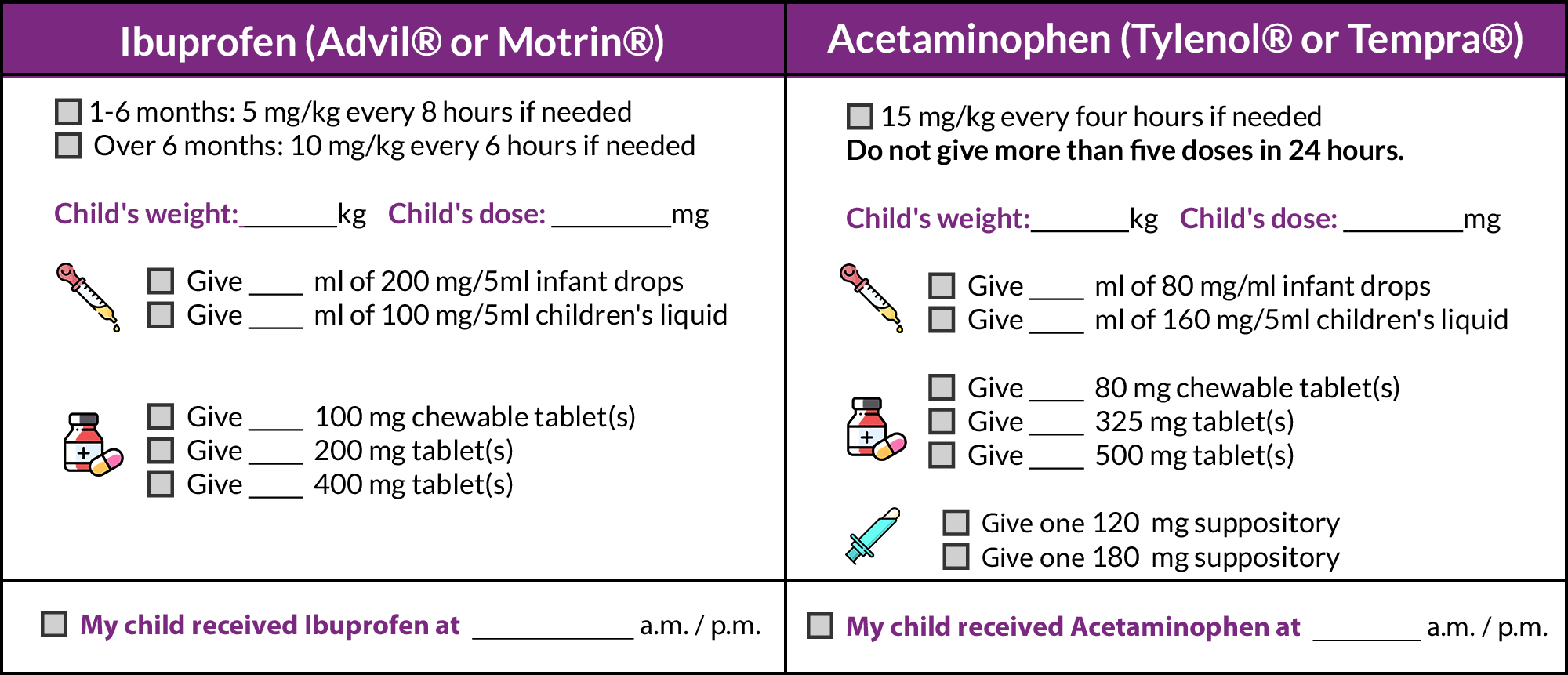
Ibuprofen and acetaminophen can make your child more comfortable by bringing down the fever a little. Most children will not need both medications.
When your child has a fever:
- Try ibuprofen first, as it works better for most children.
- Use acetaminophen instead of ibuprofen if your child has chicken pox.
- Try acetaminophen if your child does not improve one hour after ibuprofen.
- Do not use Aspirin® (ASA).
Always give the dose based on your child’s weight, not age. Check the concentration on the bottle carefully.
Febrile seizures
Febrile seizures happen in about 1 in 20 children with a fever. These seizures are usually brief, lasting only a few minutes, and do not cause long-term problems. Fever medicine does not prevent febrile seizures.
Contact your family doctor if your child or youth:
- Has a fever for more than five days
- Is not getting better after one week of symptoms
- Develops an ear ache
Go to the Emergency Department if your child or youth:
- Is under three months old and has a fever
- Is very irritable or sleepy and does not improve with medicine
- Has difficulty breathing
- Has signs of dehydration (dry mouth, not peeing at least every eight hours)
- Has a headache or sore neck that does not go away with fever or pain medicine
Need Help Right Now?
Disclaimer
These resources are for educational purposes only. If you have questions, speak with your health care provider. Last updated: June 2026
Have you registered for MyChart?
MyChart is a free, secure, online patient portal that connects patients to parts of their CHEO electronic health record, anywhere, at any time.