
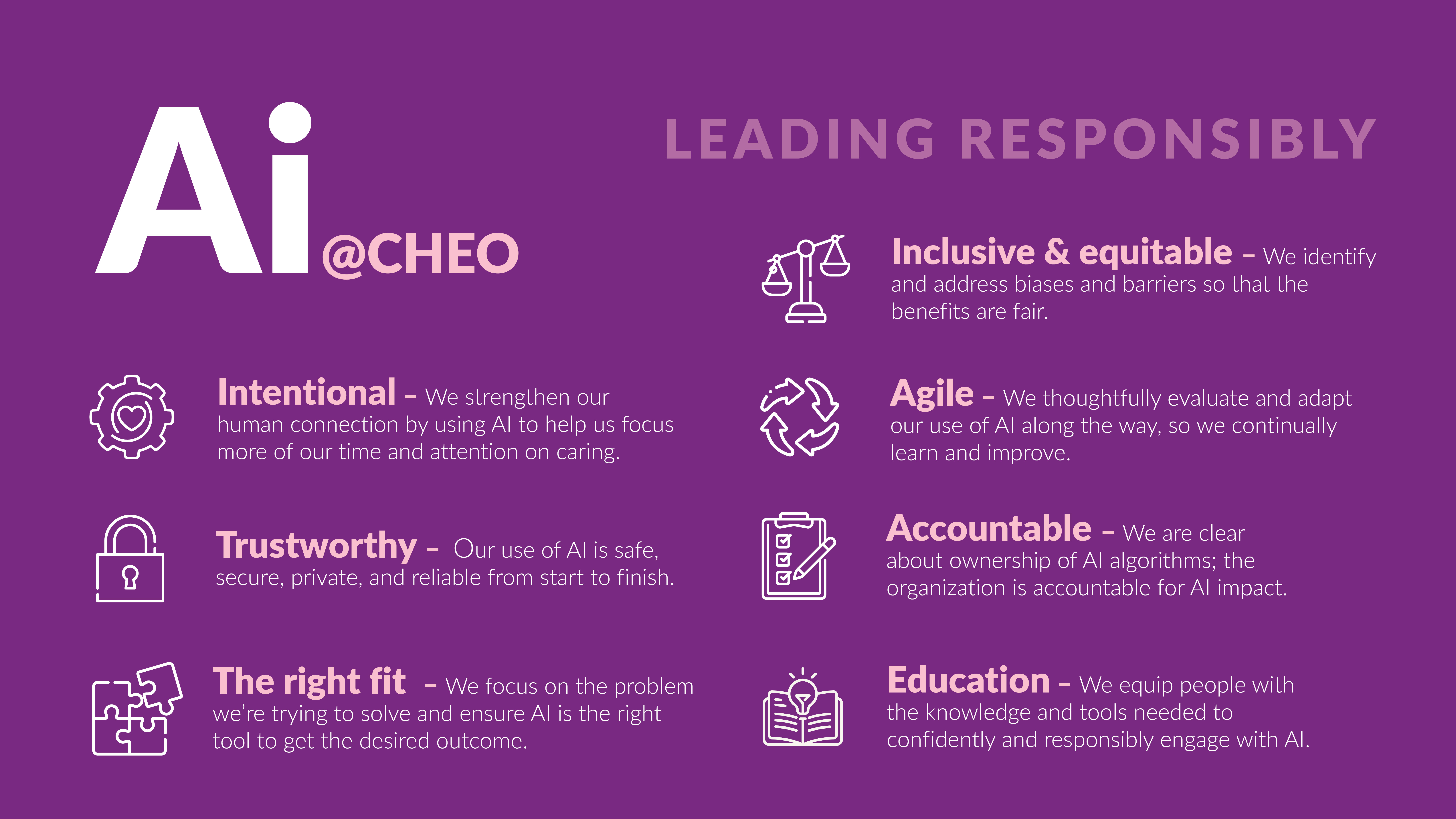
- Intentional: We strengthen our human connection by using AI to help us focus more of our time and attention on caring.
- Trustworthy: Our use of AI is safe, secure, private, and reliable from start to finish.
- The Right Fit: We focus on the problem we’re trying to solve and ensure AI is the right tool to get the desired outcome..
- Inclusive & Equitable: We identify and address biases and barriers so that the benefits are fair.
- Agile: We thoughtfully evaluate and adapt our use of AI along the way, so we continually learn and improve.
- Accountable: We are clear about ownership of AI algorithms, the organization is accountable for AI impact.
- Education: We equip people with the knowledge and tools needed to confidently and responsibly engage with AI.
Artificial Intelligence at CHEO
Our commitment to responsible AI
We believe that innovation in pediatric health must always be safe, thoughtful and grounded in strong values. That’s why CHEO follows a principled, human-centred approach to AI. Our Responsible AI Framework guides how we evaluate, design, and use AI tools.
Learn about our AI framework and principles
How you may experience AI at CHEO
At CHEO, AI is a tool to support care. Here is how you may experience AI when you visit digitally or physically:
-
AI-assisted educational content
Some patient and family education materials may be created or supported with the help of AI tools. All content is reviewed and approved by CHEO clinical experts to ensure it is accurate, safe and appropriate.
-
AI-assisted notetaking during clinical visits
With patient awareness and consent, some clinicians may use AI-assisted note-taking tools during visits. This helps clinicians focus more on the conversation and the patient. Clinicians always review, edit, and approve any clinical documentation before it becomes part of the medical record.
-
AI-research
We are harnessing the power of AI to advance discoveries and enhance patient care while prioritizing safety, ethics, privacy and responsibility. Explore our research that is helping transform health care through the responsible application of AI. No patient information is used for research without explicit consent.
Patient and family perspectives inform how AI is designed, reviewed, and used at CHEO.
AI-powered insights could help youth get the right care sooner for eating disorders
A new study led by the CHEO Research Institute’s Stephanie Ryall, Nicole Obeid, and Khaled El Emam is the first ever to apply machine learning to predict clinical eating disorder outcomes in youth.
Using data from over 300 adolescents treated at CHEO’s Eating Disorders Program, researchers compared seven machine learning models trained on clinical characteristics from the first treatment episode to traditional statistical methods to predict which youth were likely to need readmission or receive more intensive care.

AI predictive screening shows potential to provide earlier and more accurate detection of autism spectrum disorder
A team of researchers has harnessed the power of artificial intelligence (AI) to better predict autism spectrum disorder (ASD), by training an AI model to analyze large-scale health administrative and registry data.
This work represents a foundational step toward a future where AI-enhanced screening can help ensure no child is left behind due to late recognition of ASD.
World-first ThinkRare algorithm helps family get early diagnosis of rare genetic disorder
CHEO's world-first ThinkRare algorithm is improving the lives of children, youth, and families by helping to flag some of the youngest patients who may have undiagnosed rare diseases, which answers important medical questions sooner.
AI and privacy
Your privacy, safety and security are always our priority. CHEO follows strict privacy and security rules, including Ontario laws, to keep your health information safe. Visit our Privacy and confidentiality page to learn more about our commitment to keeping your information private and secure.
Questions? Please reach out to ai@cheo.on.ca
Have you registered for MyChart?
MyChart is a free, secure, online patient portal that connects patients to parts of their CHEO electronic health record, anywhere, at any time.